I don’t know about you, but at the moment, there seems to be a constant stream of notifications about disturbing events from around the world. Between 24-hour news cycles, social unrest, political events, and the ongoing cost of living, many of us are finding daily life increasingly challenging and emotionally taxing.
When situations feel entirely outside of our influence, feeling anxious, helpless, and emotionally drained is a natural response. Because we receive notifications on our devices 24/7, it is easy to fall into doomscrolling, continuously consuming endless streams of bad news. We then end up worrying about worst-case scenarios or carrying a heavy weight of responsibility for global issues we cannot fix on our own.
If you are feeling overwhelmed by world events or sudden life changes, remember: your emotional response is completely valid.
This blog explores why external events impact our mental well-being, four practical steps to manage news-related anxiety, and how counselling can help you regain a sense of agency.
Why Global Events Trigger Anxiety
As human beings, we are hardwired to seek safety, predictability, and structure. When global external events such as political uncertainty, economic pressures, or sudden crises dominate our daily updates, our nervous system can interpret this uncertainty as a direct threat to our personal safety.
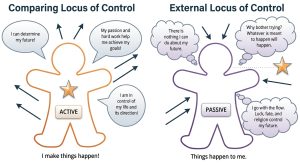
In psychological terms, this dynamic relates closely to psychologist Julian Rotter’s concept of the Locus of Control:
- Internal Locus of Control: Believing that you have agency over your choices, actions, and immediate environment.
- External Locus of Control: Feeling that outside forces, fate, or global circumstances dictate your well-being and daily life.
When distressing news can feel all consuming, our mindset naturally shifts toward an external locus of control. Over time, this state can lead to chronic stress, nervous system dysregulation, and emotional fatigue.
4 Practical Steps to Manage Anxiety About World Events
While none of us can single-handedly resolve complex global challenges, we can regain agency over our immediate routine and emotional well-being.
1. Focus on Your "Circle for Influence"
A useful exercise adapted from Stephen Covey’s framework is drawing two concentric circles on a piece of paper:
- The Outer Circle (Circle of Concern): Include global politics, the macro-economy, and other people's choices, things you care about, but cannot directly control.
- The Inner Circle (Circle of Influence): Include your daily routine, boundaries around device use, news intake, self-care practices, and local community connections.
By consciously directing your energy toward your inner circle, we can often reduce feelings of powerlessness and reclaim personal agency.
2. Establish Healthy Digital Boundaries
Staying informed is understandable, but continuous exposure keeps your nervous system stuck in persistent fight or flight response.
- Turn off push alerts: Disable real-time news notifications on your phone and tablet.
- Schedule check-ins: Designate specific, limited times (e.g., 15 minutes in the afternoon) to read news updates, rather than checking continuously.
- Set Do Not Disturb schedules: Avoid news consumption first thing in the morning and right before bed.
- Create screen-free evenings: Replace late-night phone scrolling with calming, tactile habits like reading, listening to music, or gentle stretching.
3. Practice Somatic Grounding
When anxious thought spiral into worst case scenarios, bringing your awareness back to your physical body helps quiet the nervous system. The 5-4-3-2-1 Grounding Method is a reliable technique to anchor yourself in the present moment:
- 5 things you can see around you.
- 4 things you can physically touch or feel.
- 3 things you can hear.
- 2 things you can smell.
- 1 thing you can taste.
4. Take Small, Meaningful Actions
Transforming feelings of helplessness into constructive action can reduce emotional burden. Supporting a local community initiative, volunteering, donating, or reaching out to a neighbour in need translates abstract concern into tangible positive impact.
How Counselling Can Support You
Many people assume therapy is only for resolving a specific personal crisis or interpersonal issue. However, counselling is equally valuable for processing the distress caused by external stressors. Therapy isn't about ignoring global realities; it provides a safe, contained space to process how these events impact you personally, helping build emotional resilience so you can navigate uncertainty without feeling overwhelmed.
Here is how integrative counselling supports you through external uncertainty:
- A Dedicated Space to Express Yourself: Express fear, sadness, or frustration freely without needing to put on a brave face.
- Unpacking Underlying Stressors: External events often act as a focal point for deeper, pre-existing anxieties or past experiences. Therapy helps clarify why specific news events trigger particularly strong reactions.
- Reclaiming Personal Agency: Clarify where you have choice, set healthy boundaries around your time and energy, and realign with your personal values.
- Cultivating Long-Term Resilience: Drawing on humanistic and cognitive therapeutic approaches, integrative therapy supports you in processing complex emotions, lowering physiological anxiety, and fostering self-compassion.
Finding Professional Support
Feeling deeply impacted by a turbulent world is a natural reflection of empathy and human connection. You do not have to carry anxiety, burn-out, or uncertainty alone.
At Sophie Hughes Counselling, I offer professional, empathetic counselling sessions in Haywards Heath, West Sussex, as well as online therapy across the UK. Together, we can work through feelings of overwhelm, restore emotional balance, and help you find a calm, grounded path forward.
Ready to take the next step? Get in touch today to arrange an initial consultation.
References & Further Reading
- Mental Health Foundation UK: Managing Mental Health During Traumatic World Events
- Bupa UK: Coping with Anxiety About World Events
- Rotter, J. B. (1966): Generalized expectancies for internal versus external control of reinforcement.Psychological Monographs: General and Applied.
- Simply Psychology: Locus of Control Theory Explained